
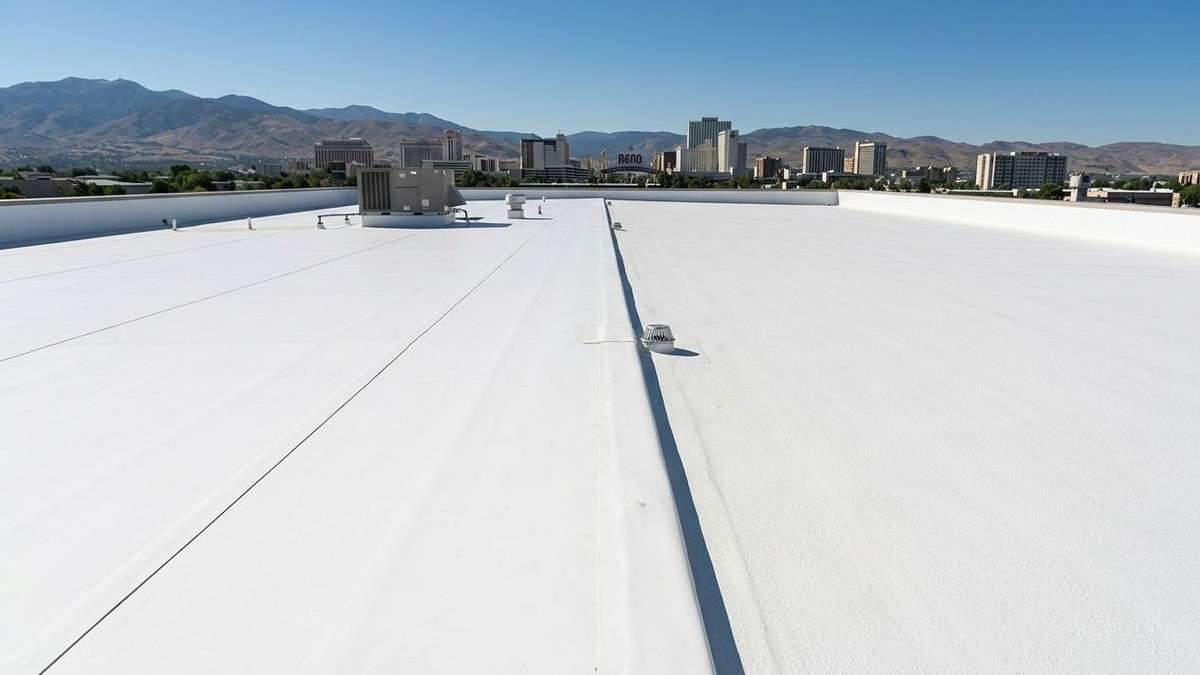
SPF vs TPO roofing Reno property owners often ask about when it’s time to replace or upgrade a commercial roof. Both are legitimate commercial roofing systems, but they solve the problem differently — TPO is a single-ply membrane installed in sheets, while SPF is a seamless, sprayed-on system. For most flat and low-slope buildings in the Reno area, SPF tends to offer more long-term value, though TPO and PVC both remain common systems already in use across the region.
If you’re researching a roof replacement and keep seeing these terms, here’s a straightforward comparison to help make sense of the options.
Table of Contents
What Is TPO Roofing
TPO, or thermoplastic polyolefin, is a single-ply membrane roofing system. It comes in large rolled sheets that get mechanically fastened or adhered to the roof deck, with seams heat-welded together at the overlaps. It’s a widely used commercial roofing material, known for being relatively affordable to install and offering decent reflectivity in its white form.
The trade-off is that a TPO roof is only as strong as its seams. Every seam is a potential failure point, and as a building ages, seam separation is one of the most common reasons a TPO roof starts leaking. Sun exposure and thermal cycling — the constant expansion and contraction between hot days and cool nights — put ongoing stress on those seams over years of service.
What Is PVC Roofing
PVC, or polyvinyl chloride, is another single-ply membrane system, similar in installation method to TPO but with different chemical properties. PVC roofing tends to hold up well against chemical exposure and grease, which is part of why it’s sometimes chosen for buildings like restaurants with rooftop kitchen exhaust.
Like TPO, PVC roofing is installed in sheets with heat-welded seams, which means it carries the same fundamental vulnerability — seams that can degrade and separate over time, particularly as the membrane ages. PVC does tend to command a higher upfront cost than TPO, which is often offset by its added chemical resistance in the specific applications where that resistance matters.
What Is SPF Roofing
SPF, spray polyurethane foam, takes a fundamentally different approach. Instead of sheets and seams, SPF is sprayed on as a liquid that expands into a solid foam layer, following the exact shape of the roof deck and everything on it — vents, HVAC curbs, skylights, drains. Once cured, it’s covered with a reflective protective coating.
Because there are no seams in an SPF system, there’s no seam failure to worry about. The entire roof surface is one continuous, fully adhered layer, which changes the calculus on long-term maintenance and leak risk compared to a sheet-based system. SPF also conforms tightly around equipment curbs, drains, and other penetrations, areas where membrane systems often need extra flashing work to seal properly.
Where TPO and PVC Fall Short
Both TPO and PVC are reasonable roofing systems, and plenty of buildings in the Reno area currently have one installed and performing fine. But both share the same core vulnerability: seams. As a membrane roof ages, especially through repeated cycles of intense summer heat and winter cold, seams are the first place issues tend to show up — lifting, separation, or gradual failure of the heat-welded bond.
Membrane systems also typically require full tear-off and replacement once they reach the end of their service life, rather than the recoat-and-extend approach available with SPF. That means the full cost of replacement comes due again on a fixed cycle, rather than being spread out through periodic maintenance. Over a building’s lifetime, this can mean multiple full replacements for a membrane roof versus a series of less disruptive recoats for an SPF system.
If you currently have a TPO or PVC roof that’s developing leaks, especially seam-related ones, that’s often a sign the system is approaching the point where a full replacement — rather than another round of seam repairs — is the more practical path forward. That’s also the point where it’s worth comparing what a membrane replacement would cost against switching to a seamless SPF system instead.
Why SPF Is Often the Better Long-Term Choice
For flat and low-slope commercial roofs in Reno’s climate — intense summer sun, real temperature swings, occasional heavy snow — SPF’s seamless design and recoat-based maintenance cycle tend to offer better long-term value than a membrane system that requires full replacement on a fixed timeline.
This doesn’t mean TPO or PVC are bad choices in every situation. Budget constraints, specific building requirements, or a roof that’s not due for replacement yet are all legitimate reasons a membrane system might still make sense. But for a building owner planning a replacement or major roofing decision, SPF is worth serious consideration precisely because it addresses the most common failure point of the alternatives.
Frequently Asked Questions
Can SPF be installed over an existing TPO or PVC roof? In many cases, yes, depending on the condition of the existing membrane. This can reduce tear-off costs compared to a full replacement, though it requires an assessment of the current roof to confirm it’s a suitable base.
Is SPF more expensive than TPO or PVC upfront? Costs vary by project and building specifics. The more relevant comparison is often long-term cost, since SPF’s recoat cycle can extend the roof’s service life well beyond a membrane system’s typical replacement timeline.
How do I know if my TPO or PVC roof needs to be replaced? Frequent seam-related leaks, visible membrane shrinkage or wrinkling, and a roof approaching or past its expected service life are all signs worth having assessed by a roofing professional. A direct inspection can usually tell you whether targeted seam repairs still make sense or whether the roof has reached the point where replacement is the more cost-effective path.
Considering Your Options?
Whether you currently have TPO, PVC, or an aging roof of any kind, our team can walk you through whether SPF makes sense for your commercial roofing project in the Reno area, with a straightforward comparison based on your building’s specific condition.
Call 775.831.4188 or 775-200-9440, or visit roofcrafterswest.com to schedule a consultation.